The supplier who never got chosen
A manager I was working with (let's call her Sarah, because half of the managers I meet seem to be called Sarah) handed a job to someone in her team. "Can you sort the new supplier?" Simple enough. She ticked it off in her head and moved on.
Two weeks later she was fuming. Nothing had happened. The old contract was about to run out, and she was back to sorting it herself at nine o'clock at night.
Her team member was just as confused. He'd sent her three options on day two. He'd been waiting ever since for her to pick one.
Nobody did anything wrong. They just heard two completely different jobs. She thought she'd said "sort it and let me know". He heard "look into it and wait for me".
I see this pattern in sessions every single week. And it's one of the main reasons owners tell me "everything keeps coming back to me".
It's usually not the person. It's the handover.
When a job bounces back, the easy conclusion is that the person can't be trusted with it. So you take it back, do it yourself, and quietly decide not to hand that sort of thing over again. (Which is how you end up doing the rota, the supplier calls and the awkward conversation with Dave about his timekeeping, all while paying a manager to do them.)
But most of the time, the person did exactly what they thought you asked. The problem is that you never told them how much freedom they had.
And it's not surprising nobody's taught them. The CMI found that 82% of people who step into management have had no formal training. Most managers are making handovers up as they go, because nobody ever showed them a better way.
Say the number
The fix is simple. When you hand something over, say which number it is. Out loud. At the start.
- Do it my way. Exactly as asked. Good for brand new starters and anything with no wiggle room, like a legal process or a client's very specific request.
- Find out and tell me. Look into it and come back with what you've found. I'll decide.
- Tell me what you'd do. Bring me your recommendation. I'll say yes or no.
- Do it, tell me after. You decide and act. Let me know how it went.
- It's yours. Fully owned. No need to report back.
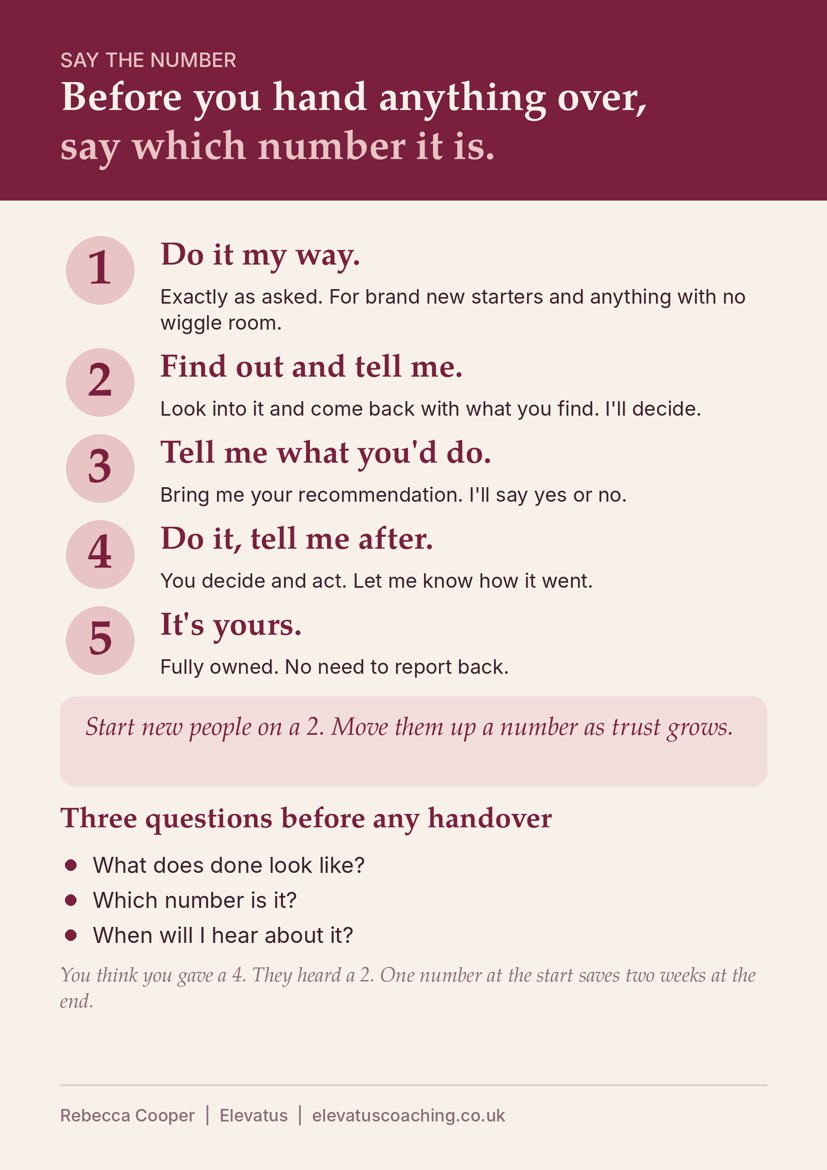
There are a few versions of this idea around (Michael Hyatt has a good one in his book Free to Focus). This is the one I use with managers, because it's short enough to remember in the middle of a busy Tuesday.
Go back to the supplier. Sarah thought she'd given a 4. Her team member heard a 2. If she'd said "this one's a 4, pick the best option, sign it off and tell me which one you went with", it would have been done in a week. One number at the start would have saved two weeks at the end.
Three questions before any handover
The number does most of the work, but it helps to pair it with three questions. I ask managers to keep these by the desk until they become habit.
- What does done look like? Be specific. "Sorted" means different things to different people.
- Which number is it? Say it, and check they've heard the same thing.
- When will I hear about it? Agree it now, so nobody's left wondering whether to chase.
It takes about thirty seconds. It saves the endless back and forth, the "I thought you were doing that" conversations, and the evening catch up where you redo someone else's work.
Start low, move up
Here's the bit most managers skip. The number isn't fixed to the person. It's fixed to the person and the task, and it should move over time.
Start a new team member on a 2 for most things. As they show good judgement, move them to a 3, then a 4. That's how trust gets built on purpose, rather than by accident. And it gives your team a clear sense of progress: they can see themselves being trusted with more.
It also changes the conversation when something goes wrong. Instead of "why did you do that?", you can ask "what number did you think this was?" That's a much easier question to answer, and it usually shows you exactly where the handover broke down.
How this fits with RACI and DACI
If you've read my posts on RACI and team ownership, you'll know I'm a fan of being clear about who owns what. The number system sits alongside it nicely.
- RACI tells you who owns the task.
- DACI tells you who makes the decision.
- The number tells them how much freedom they've got while they do it.
Use all three and most of the "it keeps coming back to me" problem disappears.
Try it this week
Next time you hand something over, say the number out loud. Then watch what happens. My bet is you'll get fewer questions, fewer surprises, and fewer jobs landing back on your desk on a Friday afternoon.
And if you're an owner reading this, ask your manager: "When you hand things to the team, do you tell them what number it is?" Their answer will tell you a lot.
Want help with this?
This is exactly the sort of thing we work on in New Manager Mentoring: three months of private one to one sessions for managers who were brilliant at the job and are now figuring out how to lead the people doing it. Not a course. Not a workbook you'll never open. Proper conversations about the real stuff.
I'm opening six places in January 2027. Join the waitlist and we'll have a proper conversation first.
Join the waitlistNot ready for that yet? Take the free Team Independence Check to see how much of your team's work still depends on you.
Founder, Elevatus Coaching
Rebecca mentors UK business owners and the managers they've promoted, drawing on more than 20 years in recruitment and people development.
Elevatus Coaching Ltd · elevatuscoaching.co.uk